
Basement Ceiling Leak Repair and Finding the Source
A Basement Ceiling Leak Can Cause Serious Damage Fast — Here's What to Do
Basement ceiling leak repair is urgent and should follow these steps as soon as you notice water:
Shut off the water supply if a plumbing source is suspected
Turn off electricity in the affected area at the breaker box
Move furniture and valuables away from the leak
Place buckets under active drips to contain water
Puncture any bulging ceiling at its lowest point to release trapped water in a controlled way
Document all damage with photos or video for your insurance claim
Call a professional — a plumber, roofer, or emergency restoration specialist depending on the source
You come home and notice a brown stain spreading across your basement ceiling. Or worse — water is actively dripping, and you can already smell that musty odor that signals mold is close behind.
This is not a minor inconvenience. A water leak in your basement ceiling can signal hidden damage inside your walls, above your subfloor, or deep in your roofing system. And in Georgia's humid climate, mold can start growing in as little as 24 to 48 hours after water intrusion begins.
The longer you wait, the worse — and more expensive — it gets.
This guide walks you through exactly how to find the source of the leak, what to do right now to limit the damage, and how professionals repair a water-damaged basement ceiling from start to finish.
Identifying the Warning Signs of a Basement Ceiling Leak
Before a full-blown "indoor rainstorm" begins, your home usually tries to tell you something is wrong. Recognizing these signs early can save you thousands in structural repairs and mold remediation.

Discoloration and Stains: The most common sign is a yellow, dark, or rust-colored stain. These often appear as "water rings" with a darker outer edge.
Sagging Drywall or Plaster: When drywall absorbs water, it becomes heavy and loses its structural integrity. If you notice a section of the ceiling bowing downward, it is holding a pool of water that needs immediate release.
Bubbling Paint and Peeling Wallpaper: Water often gets trapped behind the layer of paint, creating "balloons" of water. In other cases, the moisture destroys the adhesive on wallpaper, causing it to curl or peel away.
Musty Odors: That "old basement" smell is often actually the scent of damp insulation or wood rot. If a room smells earthy or sour, there is likely moisture trapped behind the ceiling panels.
Efflorescence: If you have an unfinished basement with concrete ceilings or walls, you might see a white, powdery substance. This is efflorescence—mineral deposits left behind as water evaporates.
Damp Insulation: If you can peek above a ceiling tile or through a gap, feel the insulation. Wet fiberglass or cellulose insulation loses its R-value and becomes a breeding ground for bacteria.
Warped Floor Joists: In severe cases, prolonged exposure to moisture can cause the wooden joists supporting your first floor to swell, twist, or rot.
If you are unsure if a spot is active or old, How to Troubleshoot and Repair a Leaking Ceiling suggests marking the perimeter of the stain with a pencil. If the stain grows past that line after the next rain or shower, you have an active leak.
How to Pinpoint the Source of the Water
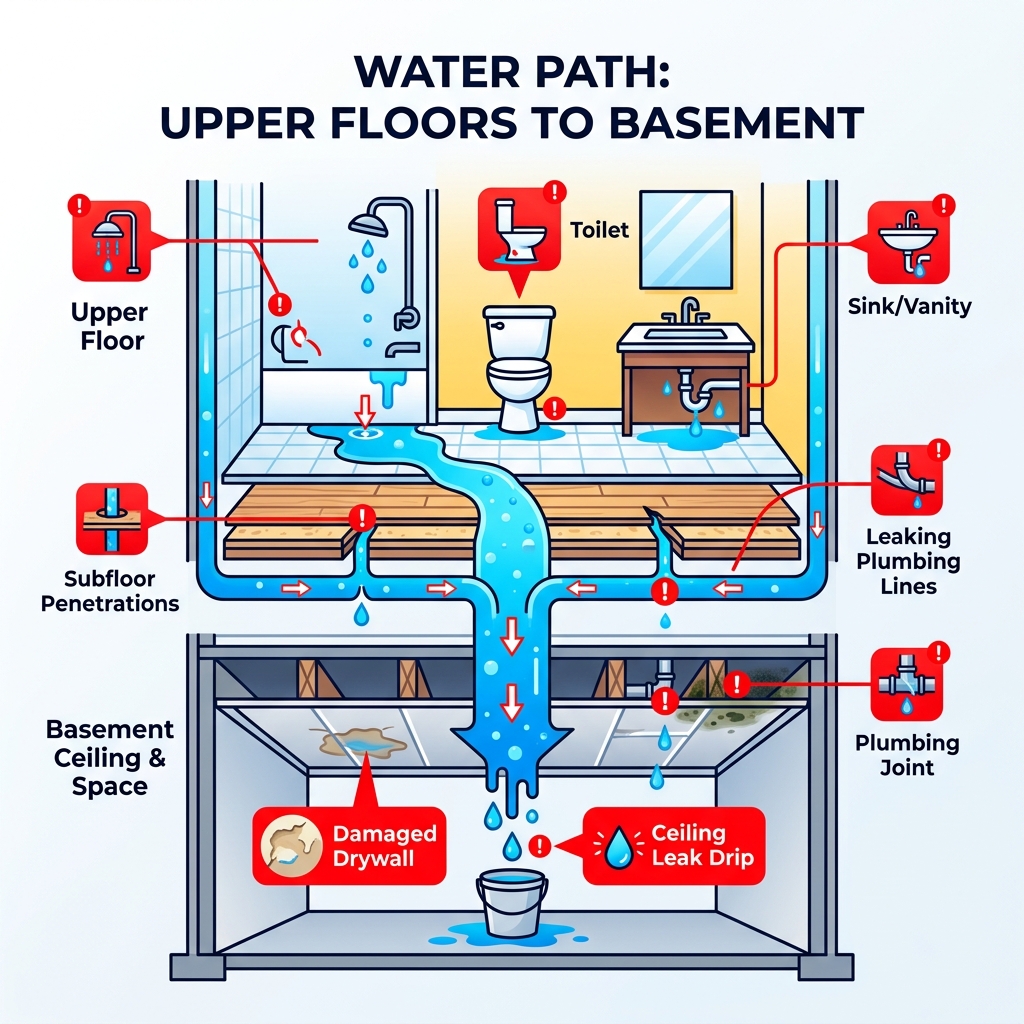
Finding the "drip" is easy; finding the "source" is the real challenge. Water rarely travels in a straight line. It often hits a joist, travels horizontally for several feet, and then drips down in a completely different area.
Feature Plumbing Leak Roof or Exterior Leak Timing Constant or happens after using a fixture Happens during or after rain/snow melt Water Color Usually clear (unless sewage) Often tea-colored or dark (picks up debris) Stain Shape Often circular or focused May be cone-shaped or follow a joist line Odor May smell like "swamp water" or sulfur Usually musty or earthy
Common Causes of a Basement Ceiling Leak Repair Need
When we are called for an emergency basement ceiling leak repair in Georgia, the culprit usually falls into one of these categories:
Toilet Wax Rings: The wax ring seals the toilet to the floor. If it fails, water leaks into the subfloor every time the toilet is flushed. You might not even see water on the bathroom floor, but it’s soaking the basement ceiling below.
Shower Pan Failure: Cracked tiles or a failing waterproof membrane in a walk-in shower can allow gallons of water to seep through the floorboards.
Leaky P-Traps: The U-shaped pipe under sinks can develop pinhole leaks or loose connections.
Supply Line Bursts: These are high-pressure leaks. If a copper or PEX pipe bursts, it will cause an immediate, heavy flow of water.
Appliance Malfunctions: Washing machines and dishwashers are common offenders. A cracked hose or a faulty pump can dump 30+ gallons of water in minutes.
Condensation: In Georgia’s humid summers, cold water pipes can "sweat." This condensation can drip enough to create small water spots that look like leaks.
HVAC Drainage: If your AC unit’s primary condensate drain line clogs, the backup pan can overflow directly into the ceiling.
Diagnostic Techniques to Find the Leak
To find the exact entry point, we use several professional methods:
Triangulation: We measure the distance of the leak from two permanent walls and then go to the floor above to see what fixtures (toilets, sinks, showers) are located in that exact footprint.
The Tissue Paper Test: Wrap dry tissue paper around suspected pipes or joists. Even a tiny "weeping" leak will immediately discolor the paper, making it easy to spot.
Thermal Imaging: We use infrared cameras to see "cold spots" behind walls. Water is typically colder than the surrounding building materials, allowing us to trace the path of the moisture without cutting holes in your drywall.
Garden Hose Test: If we suspect a roof or siding leak, one technician stays in the basement while another uses a hose to soak specific areas of the home's exterior to see when the dripping starts.
Immediate Steps for Basement Ceiling Leak Repair
When water is actively coming through the ceiling, you have to act like a first responder. Your goal is to stop the flow and protect your property.
Draining the Bulge: It sounds counterintuitive to poke a hole in your ceiling, but if the drywall is sagging, it’s acting like a heavy water balloon. Use a screwdriver or an ice pick to puncture the center of the bulge. This allows the water to drain into a bucket in a controlled way, preventing the entire ceiling section from collapsing under the weight.
Electrical Safety: Water and electricity are a deadly combination. If water is dripping near a light fixture or outlet, turn off the power to that circuit immediately.
Containment: Use large buckets or plastic bins. If the drip is splashing, place a heavy towel at the bottom of the bucket to silence the noise and prevent splashing onto the floor.
Documenting Damage: Before you start cleaning up, take photos. Your insurance adjuster needs to see the "before" state to accurately process your claim.
For more on protecting your foundation during these events, see our Complete Basement Waterproofing Guide: How to Stop Leaks and Protect Your Foundation.
The Professional Restoration and Repair Process
Once the source is fixed (by a plumber or roofer), the restoration work begins. Simply "letting it air dry" is rarely enough because moisture gets trapped in the dark, unventilated spaces between the ceiling and the floor above.
Professional Basement Ceiling Leak Repair Steps
Our process at ProShield 24/7 involves more than just a patch of drywall. We ensure the environment is safe and dry:
Material Demolition: We remove all water-saturated drywall and insulation. These materials act like sponges and cannot be effectively dried once they lose their shape.
Structural Drying: We use industrial-grade air movers and LGR (Low Grain Refrigerant) dehumidifiers. These machines pull moisture out of the wooden joists and subflooring that you can't see.
Antimicrobial Treatment: To prevent mold, we apply professional-grade antimicrobials to the remaining structural wood.
Moisture Monitoring: We don't guess. We use moisture meters to confirm the wood has reached its "dry standard" before we seal it back up.
Reconstruction: Finally, we install new insulation, hang new drywall, match the existing texture (popcorn, orange peel, or smooth), and apply a fresh coat of paint.
For complex wall-related leaks, experts like those at This Old House often recommend specific masonry techniques, as seen in How To Fix a Leaky Basement Wall in Easy to Follow Steps - This Old House.
Who to Call for Help
Licensed Plumber: Call them first if the leak is constant or related to using water fixtures.
Roofing Contractor: Call them if the leak only appears during rainstorms.
Emergency Restoration Specialists (ProShield 24/7): Call us to handle the extraction, drying, mold prevention, and full ceiling reconstruction. We coordinate with your insurance to make the process seamless.
Long-Term Prevention Strategies
The best basement ceiling leak repair is the one you never have to do. Regular maintenance can prevent 90% of household leaks.
Gutter and Downspout Maintenance: Clogged gutters cause water to back up under your shingles or overflow against your foundation. Ensure downspouts extend at least 6 feet away from your home.
Foundation Grading: Ensure the soil around your home slopes away from the foundation (at least 6 inches of drop over 10 feet).
Sump Pump Installation: If your basement is prone to groundwater issues, a sump pump with a battery backup is non-negotiable.
Smart Leak Detectors: For less than $50, you can buy Wi-Fi-enabled sensors to place under sinks or near your water heater. They will alert your phone the second they detect moisture.
Routine Plumbing Audits: Twice a year, walk through your home and check the "hidden" spots—behind the washing machine, under the kitchen sink, and around the base of every toilet.
For more on preventing floor-level water issues, check out Water Coming Up Through Basement Floor: Causes, Fixes & Costs.
Frequently Asked Questions about Basement Ceiling Leak Repair
Can a basement ceiling leak cause a collapse?
Yes. Drywall is made of gypsum and paper. When it stays wet, it becomes incredibly heavy and loses its ability to hold onto the screws. A single square foot of wet drywall can weigh several pounds; a large ceiling section can easily weigh over 100 pounds, posing a significant risk to anyone standing below.
Is a ceiling leak considered an emergency?
Absolutely. Beyond the risk of collapse, water often travels through electrical conduits. If water gets into your light fixtures or junction boxes, it creates a fire hazard. Furthermore, mold begins to colonize in as little as 24 hours. Treating a leak as an emergency now prevents a "mold emergency" next week.
How much does it cost to repair a water-damaged ceiling?
Costs vary based on the extent of the damage. On average, ceiling water damage repair can cost between $45 and $55 per square foot for the restoration alone. This does not include the cost of the plumber or roofer to fix the original source. Factors like the age of the home (asbestos or lead paint concerns) and the height of the ceiling can also influence the price.
Conclusion
A leaking basement ceiling is a race against the clock. Whether it's a failing toilet wax ring or a storm-damaged roof, the water won't stop until you intervene. By following the immediate steps of shutting off the water, draining the ceiling bulge, and calling in the pros, you can protect your Georgia home from long-term structural damage and toxic mold growth.
At ProShield 24/7, we specialize in the heavy lifting. From rapid water extraction to professional drying and full reconstruction, our team is ready to restore your basement to its pre-leak condition. We provide 24/7 emergency response throughout Georgia because we know that water damage doesn't wait for business hours.
