
Moldy Money and the True Price of Remediation
What Black Mold Really Costs — and Why It Matters Right Now
Black mold abatement cost is one of the most urgent questions homeowners face after discovering dark patches spreading across a basement wall or catching that unmistakable musty smell after a flood or leak.
Here's a quick answer:
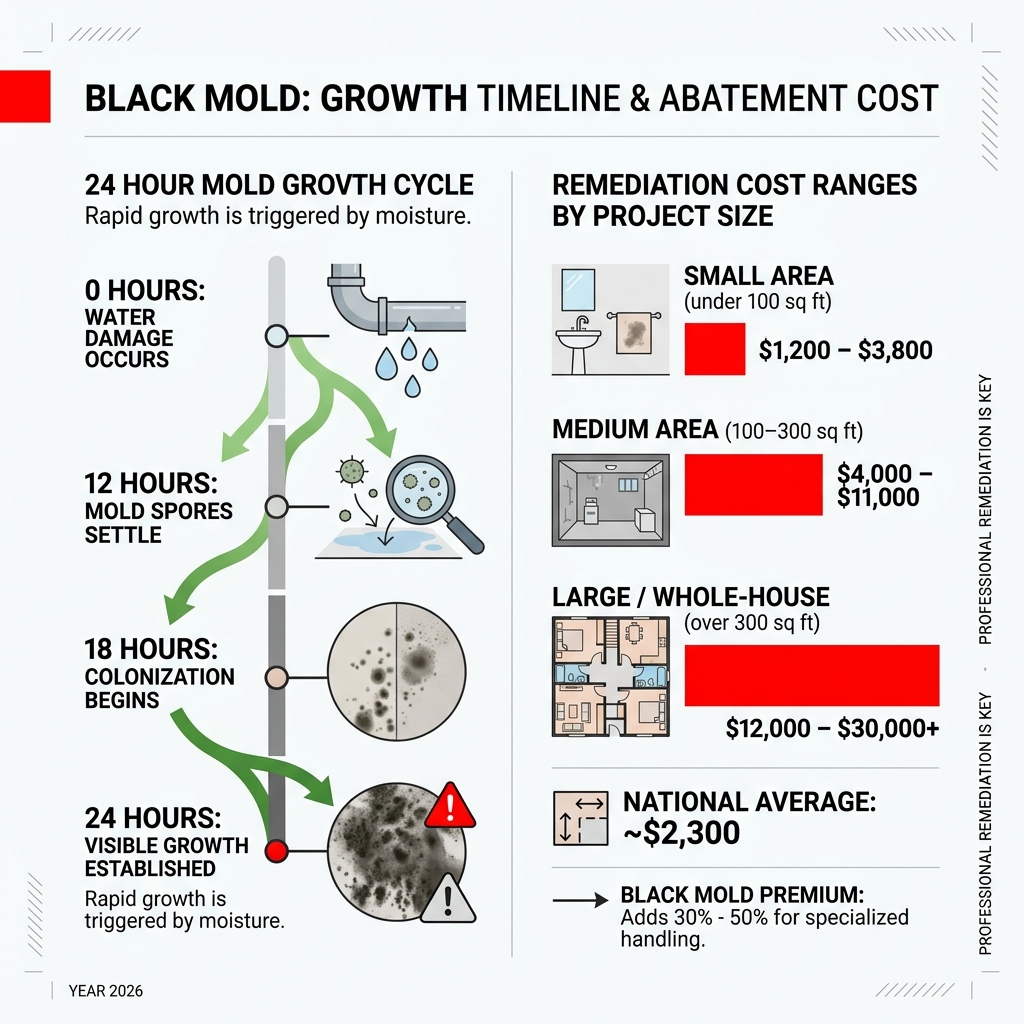
Project Size Typical Cost Range Small area (under 100 sq ft) $1,200 – $3,800 Medium area (100–300 sq ft) $4,000 – $11,000 Large / whole-house $12,000 – $30,000+ Per square foot $10 – $25 National average ~$2,300
Most homeowners pay between $1,200 and $3,750, with a national average around $2,300 for a standard remediation project.
The numbers above can feel alarming — especially in the middle of a crisis. And they get more complicated when black mold (specifically Stachybotrys chartarum) is involved, since this toxic species typically adds a 30% to 50% premium over standard mold removal due to its specialized handling requirements.
Black mold doesn't just threaten your health. It threatens your home's structure and its value. According to industry data, untreated mold contamination can depreciate a property's value by 20% to 30%. The longer you wait, the worse — and more expensive — the problem gets.
Mold can begin colonizing within 24 hours of water damage. That's not a lot of time.
This guide breaks down every cost factor so you can budget accurately, spot inflated quotes, and make smart decisions fast.
Breaking Down the Average Black Mold Abatement Cost
When we talk about the black mold abatement cost, we aren't just talking about a bottle of spray and a scrub brush. Professional remediation is a highly technical process. Nationally, the average price sits around $2,300, but for most of our neighbors here in Georgia, projects typically fall within the $1,200 to $3,750 range.
So, where does that money actually go? It’s helpful to think of the bill in three main chunks:
Labor (50%–60% of total cost): This is the biggest slice of the pie. Remediation isn't just "cleaning"; it involves setting up physical barriers, running specialized machinery, and carefully removing contaminated materials. In the Southeast, labor rates for specialized crews generally range from $40 to $90 per hour.
Equipment and Supplies (20%–25%): Professionals use industrial-grade tools you can’t find at a local hardware store. This includes HEPA (High-Efficiency Particulate Air) air scrubbers, negative air machines, and commercial-grade dehumidifiers.
Disposal and Overhead (15%–20%): Black mold is often treated as hazardous waste. It can't just be tossed in your kitchen trash can. It requires double-bagging and disposal at specific facilities that charge "tipping fees."
Black Mold Abatement Cost per Square Foot
If you're trying to do some quick "back-of-the-napkin" math, pricing by square foot is a solid starting point. On average, professional mold remediation costs between $10 and $25 per square foot.
Area Size Estimated Cost Range 50 sq ft $500 – $1,250 100 sq ft $1,000 – $2,500 200 sq ft $2,000 – $5,000 500 sq ft $5,000 – $12,500 1,000+ sq ft $10,000 – $25,000+
It is important to note that "economies of scale" do apply here. If we are remediating a very small 10-square-foot patch, the cost per square foot will be much higher because we still have to pay for the "setup"—the travel, the containment barriers, and the equipment mobilization. For whole-house or catastrophic projects (like those following a major flood), costs can soar to $30,000 or more.
Why Stachybotrys Increases Your Black Mold Abatement Cost
You might wonder, "Is black mold really that different from the green stuff on my bread?" In remediation, the answer is a resounding yes. Stachybotrys chartarum, the infamous "toxic black mold," produces mycotoxins that can cause serious respiratory issues and neurological symptoms.
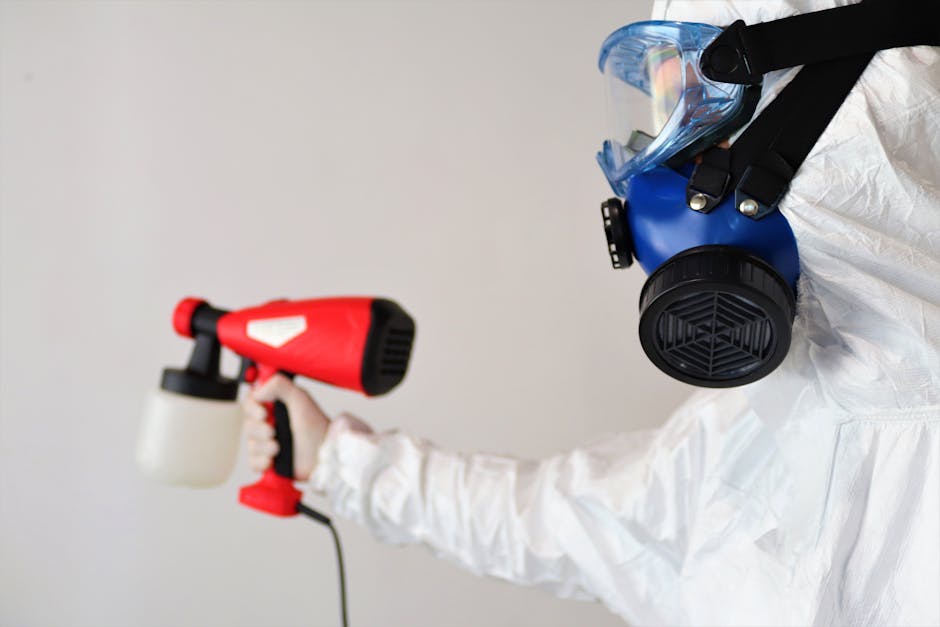
Because of these health risks, remediating black mold requires a "Level 3" or higher protocol. This includes:
Full Containment: Sealing off the area with 6-mil polyethylene sheeting and "zipper" entrances to ensure spores don't drift into the kitchen while we work in the basement.
Negative Air Pressure: Using air machines to create a vacuum effect so that air only flows into the contaminated zone, never out.
Antimicrobial Sealants: After cleaning, we often apply specialized coatings to "encapsulate" any remaining microscopic particles.
These extra safety steps are why black mold typically carries a 30% to 50% price premium over standard mold species like Aspergillus or Penicillium.
Critical Factors That Inflate Remediation Estimates
Not every $2,000 quote stays $2,000. Several "invisible" factors can send your black mold abatement cost upward once the work begins.
Hidden Colonies: Mold is an ice-berg problem. If you see a one-foot patch on the drywall, there is a high probability that the cavity behind that wall is covered in growth.
Accessibility: If our technicians have to crawl through a 24-inch high crawl space in full Tyvek suits and respirators, the labor time increases significantly compared to working in an open living room.
Moisture Source Identification: You can’t just kill the mold; you have to stop the water. If the mold was caused by a foundation crack or a slow-leaking pipe behind a vanity, those repairs add to the total project bill.
Emergency Response Premiums: Mold doesn't wait for business hours. Seeking more info about mold remediation services during a weekend or holiday can add a 20% to 40% premium to the standard rate.
Clearance Testing: Many homeowners choose to hire an independent third party to test the air after we finish. This typically costs $300 to $800 but provides the "all-clear" certificate needed for home sales.
Location-Specific Pricing: From Basements to HVAC Systems
Where the mold lives in your home changes how we have to fight it. Different areas require different equipment and levels of labor intensity.
The Unfinished Basement ($500 – $4,000)
Basements are the #1 spot for mold in Georgia due to our high humidity and "stack effect" moisture. If the basement is unfinished (exposed concrete and studs), the cost is lower because we don't have to tear out finished drywall or carpeting. However, if the foundation needs sealing to prevent future leaks, expect to add $2,250 to $7,100 for professional waterproofing.
Attics and Ductwork ($2,000 – $6,000)
Attic mold is usually caused by roof leaks or—very commonly—bathroom fans that vent into the attic instead of outside. If the mold gets into your HVAC system, the complexity skyrockets. Cleaning mold out of air handlers and ducts is labor-intensive and requires specialized "fogging" with antimicrobials. HVAC remediation alone can range from $3,000 to $10,000.
Crawl Spaces ($500 – $2,000)
Crawl spaces are notoriously difficult to work in. While the remediation itself might be affordable, many homeowners choose to pair this with encapsulation (installing a heavy-duty vapor barrier). Crawl space encapsulation in Georgia can cost anywhere from $1,500 to $15,000 but is the most effective way to prevent mold from ever returning.
Bathrooms ($500 – $1,000+)
A little mildew on the grout is a DIY fix. But if a pipe has been leaking under the tub for months, we may have to remove the vanity, the toilet, and the flooring. If structural materials are involved, a bathroom project can easily hit $8,000.
Navigating Insurance Claims and DIY Risks
One of the most common questions we get is: "Will my insurance pay for this?"
The answer depends on the cause of the mold, not the mold itself. Insurance companies generally follow the "sudden and accidental" rule.
Covered: A pipe suddenly bursts while you're at work, and mold grows within days.
Not Covered: A slow leak under the kitchen sink has been dripping for three years because of "deferred maintenance."
Not Covered (Standard Policy): A flood from heavy rain or a rising river (this requires separate Flood Insurance).
Most policies that do cover mold have a "cap" or limit, often between $5,000 and $10,000.
The DIY Danger Zone: The 10-Square-Foot Rule
The EPA and the IICRC (the body that sets industry standards) suggest that homeowners can tackle mold issues if the area is smaller than 10 square feet (roughly a 3x3 patch) and is on a hard surface like tile or metal.
However, if you have black mold or the mold is on porous material like drywall, DIY is risky. Scrubbing black mold with bleach (which is actually 90% water) can actually feed the mold roots and send millions of spores airborne, contaminating the rest of your house. By trying to save $1,000 on a small project, you could accidentally create a $10,000 whole-house problem.
Frequently Asked Questions about Black Mold
Is professional black mold removal more expensive than other types?
Yes. Because Stachybotrys chartarum is toxigenic, it requires higher levels of PPE (Personal Protective Equipment), stricter containment protocols, and more rigorous air filtration. The labor intensity is higher because we have to move slower to prevent cross-contamination. You are paying for the expertise and the insurance that the "toxic" element is truly gone.
Does homeowners insurance cover the cost of abatement?
Only if the mold is a direct result of a "covered peril." If a storm rips shingles off your roof and water gets in, you're likely covered. If the mold is there because your basement is just naturally damp and you didn't run a dehumidifier, the claim will likely be denied. Always document the water source with photos before you start cleaning!
How can I avoid overpriced remediation services?
The best way to avoid the "fear tax" is to be an informed consumer:
Get 3 Bids: Quotes for the same job can vary by thousands of dollars.
Ask for Itemization: A quote should list containment, labor, equipment, and disposal separately.
Check Certifications: Look for IICRC or NORMI certifications.
Independent Testing: Never hire the same company to test the mold and remediate the mold. This is a conflict of interest. Use a separate company for your "clearance" test to ensure the job was done right.
Conclusion
The black mold abatement cost is an investment in your family's health and your home's future. While the average price of $2,300 might seem steep, it pales in comparison to the 20% to 30% loss in home value that comes with a permanent "mold disclosure" on a real estate listing.
At ProShield 24/7, we understand that mold is an emergency. That’s why we provide immediate response with fast local dispatch throughout Georgia. We don't just "clean" the spots; we use professional drying equipment to eliminate the moisture source, ensuring the mold doesn't just come back next month.
Don't let a small patch turn into a whole-house disaster. Contact us for 24/7 mold remediation and let our experts give you the peace of mind you deserve.
