
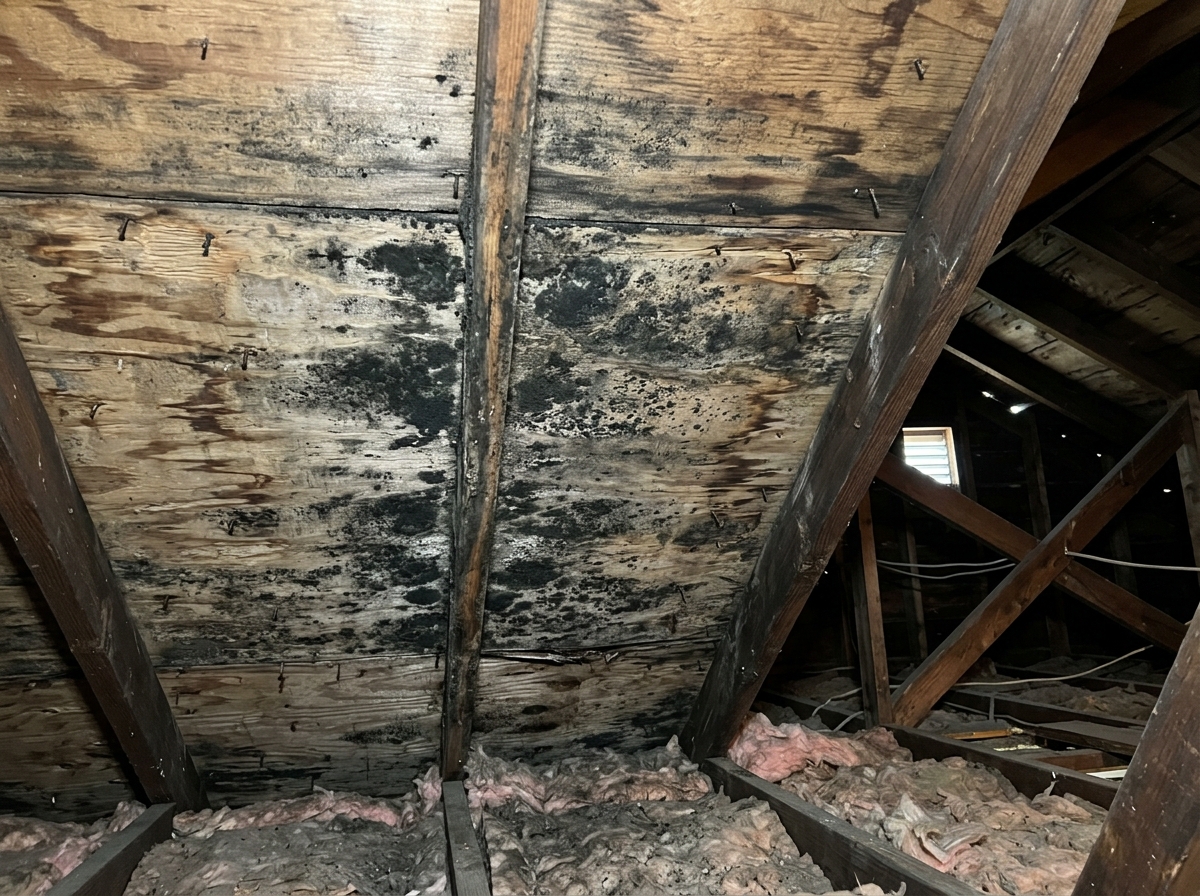
How to Evict Black Mold from Your Attic Plywood
Black Mold in Your Attic Is More Common Than You Think
Black mold in attic removal is something over 50% of American homeowners will face at some point — and many don't even know it's happening until the damage is serious.
Here's a quick overview of what the process involves:
Identify the mold - Look for dark stains, musty odors, or discoloration on roof sheathing and rafters
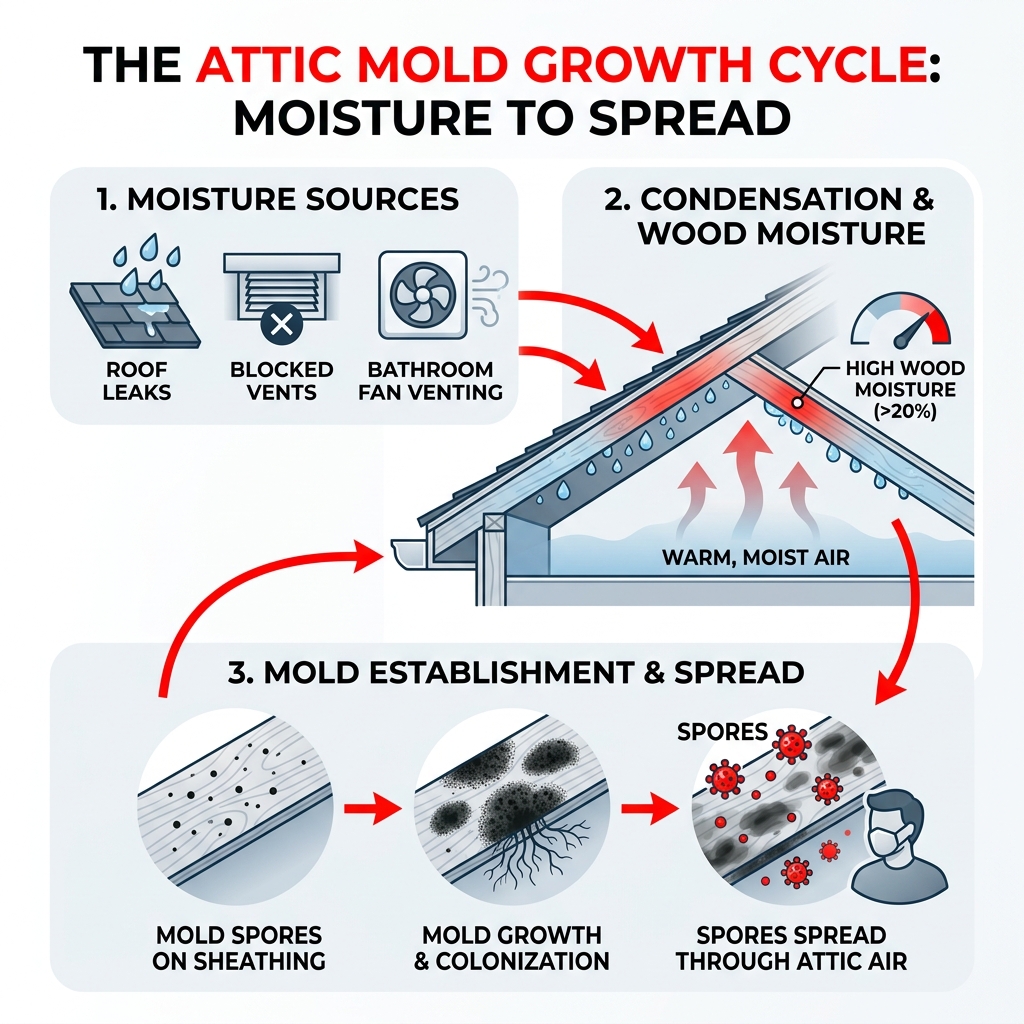
Find the moisture source - Roof leaks, blocked vents, or bathroom fans venting into the attic are the most common culprits
Contain the area - Seal off the attic to stop spores from spreading into living spaces
Remove or treat affected materials - Small areas under 10 sq ft may be DIY-friendly; anything larger needs a professional
Fix the root cause - Removing mold without fixing the moisture source means it will come back
Verify and prevent - Post-remediation testing and improved ventilation keep it from returning
That dark staining on the underside of your roof deck isn't just ugly. It can weaken your home's structure, trigger respiratory problems, and spread into your living spaces through ceiling gaps and HVAC ducts — often without you realizing it.
The tricky part? Attics are rarely visited. By the time most Georgia homeowners spot the problem, the mold has already had weeks — sometimes months — to spread across plywood and rafters.
This guide walks you through exactly what's causing it, how to remove it safely, and how to make sure it doesn't come back.
Identifying the Culprit: What Causes Black Mold in Your Attic?
Finding mold in your attic can feel like a personal affront. You might wonder, "How did this happen in a space I never even use?" The truth is, attics are the perfect laboratory for mold growth because they combine organic food sources (plywood and rafters) with high-moisture events that often go unnoticed.
In our experience serving Georgia homeowners, we see a few recurring villains. The most obvious is the roof leak. A single cracked shingle or a failed flashing around a chimney can allow water to seep onto the plywood sheathing. Once that wood hits a moisture content of 19-20%, mold spores—which are always present in the air—land and begin to feast.
However, the "stealthier" cause is condensation. During a chilly Georgia winter, warm, moist air from your kitchen or bathroom rises. If your attic isn't properly sealed, this air escapes into the attic and hits the cold underside of your roof deck. This creates "attic frost" or dew, providing the exact amount of water mold needs to thrive.
Common moisture triggers include:
Improperly Vented Exhaust Fans: If your bathroom or dryer vents dump air into the attic instead of through the roof, you are essentially pumping a "mold-growth mist" directly onto your plywood.
Poor Ventilation: If your soffit vents are blocked by insulation, the attic can't "breathe," trapping humid air inside.
Ice Dams: While less common in the Deep South than up North, unusual freezes can cause water to back up under shingles, soaking the eaves.
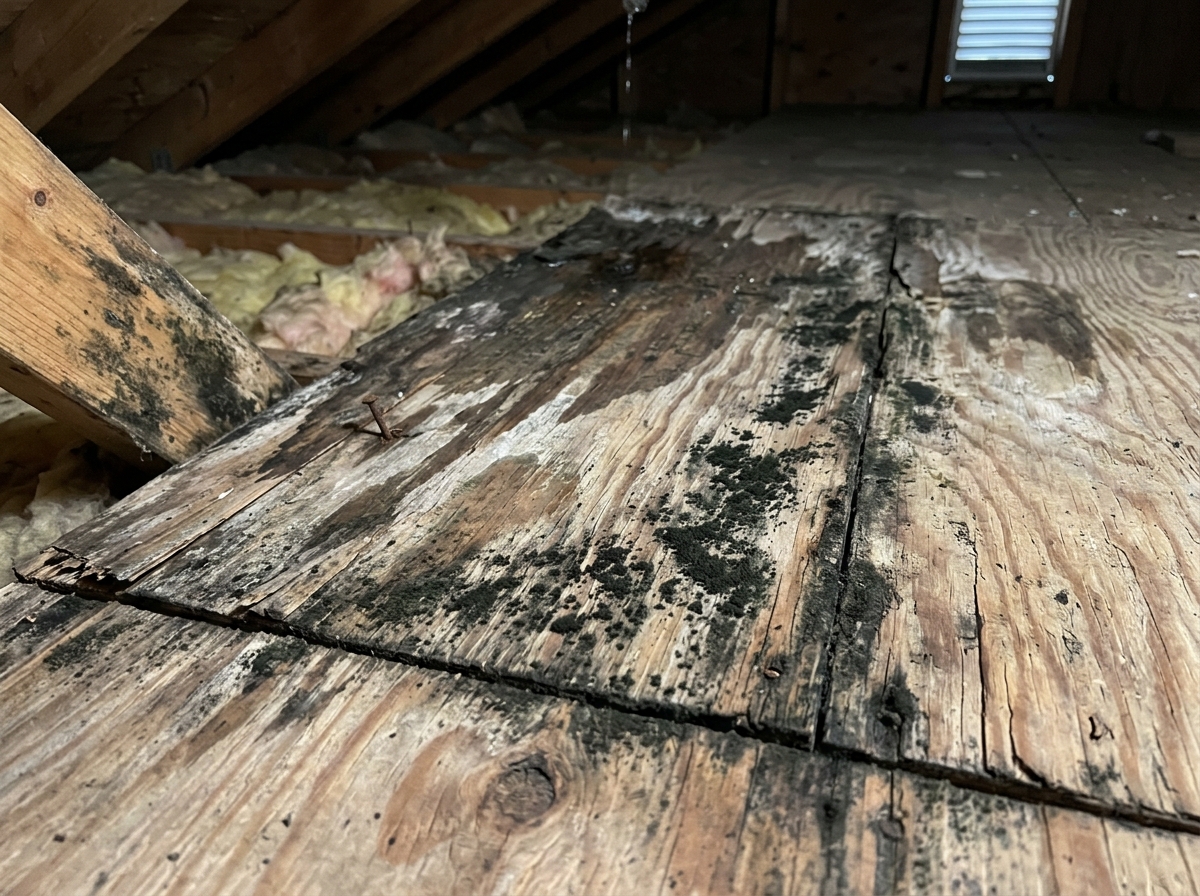
For a deeper dive into these mechanics, check out the Attic Mold Removal: Complete Guide - Mold Action Plan.
Signs of Toxic vs. Harmless Growth
Not all "black" mold is the infamous Stachybotrys chartarum (toxic black mold), but in an attic, any mold is bad news for your home's health.
Toxic Black Mold (Stachybotrys) often has a distinct slimy or wet texture and appears in dark greenish-black hues. It requires very wet conditions, like a persistent leak, to grow. On the other hand, more "common" molds might look like powdery soot or gray-white speckles.
Regardless of the color, look for these physical indicators:
Musty Odors: That "old basement" smell in a high-up attic is a dead giveaway of mold releasing volatile organic compounds (mVOCs).
Wood Decay: If you poke the plywood with a screwdriver and it feels soft or crumbly, the mold has begun to compromise the structural integrity.
Moisture Mapping: Using an infrared camera or moisture meter can reveal "hot spots" of dampness behind what looks like dry wood.
The Step-by-Step Process for Black Mold in Attic Removal
When we handle black mold in attic removal, we don't just walk in with a spray bottle and a rag. Professional remediation is a surgical process designed to kill the mold without sending millions of spores flying into your bedrooms.
The professional gold standard follows a specific sequence:
Assessment: Identifying the type of mold and the extent of the moisture damage.
Containment: We use heavy-duty polyethylene sheeting to seal the attic hatch and any vents.
Negative Air Pressure: We set up "air scrubbers" that pull air out of the attic through HEPA filters, ensuring that if any spores are disturbed, they are sucked out of the house rather than into your hallway.
HEPA Vacuuming: We use specialized vacuums that capture 99.97% of particles down to 0.3 microns.
Antimicrobial Treatment: Applying EPA-registered solutions to kill the roots of the mold embedded in the wood pores.
For more technical details on these protocols, the Attic Mold Remediation Guide | MoldReport offers a great breakdown of industry standards.
When to Choose DIY for Black Mold in Attic Removal
We understand the urge to save money, but DIY mold removal is a "know your limits" game. The Environmental Protection Agency (EPA) generally suggests that if the mold covers less than 10 square feet (roughly a 3x3 patch), a healthy homeowner can tackle it.
Feature DIY Remediation Professional Remediation Area Size Under 10 sq. ft. Over 10 sq. ft. Safety Gear N95 mask, gloves, goggles Full Tyvek suit, P100 respirator Equipment Scrub brushes, spray bottles HEPA vacuums, air scrubbers Chemicals Vinegar, Borax, Concrobium Industrial-grade biocides Risk Level High (potential spore spread) Low (full containment)
If you choose the DIY route for a small patch:
Avoid Bleach: Bleach is mostly water. On porous wood like attic plywood, the chlorine stays on top while the water soaks in, actually feeding the mold roots deeper into the wood.
Use Borax or Concrobium: These solutions penetrate the wood and "crush" the mold spores as they dry, preventing regrowth.
PPE is Non-Negotiable: Never enter a moldy attic without an N95 respirator at the very least.
Professional Techniques for Black Mold in Attic Removal
For larger infestations, professionals use high-tech methods that go beyond scrubbing.
Dry-ice blasting is a favorite in the industry. It involves "power washing" the wood with pellets of frozen CO2. The extreme cold causes the mold to shrink and detach instantly, and because the dry ice turns into gas, it leaves no liquid residue behind to cause more mold. Soda blasting (using sodium bicarbonate) is another effective, non-abrasive alternative.
After cleaning, we often apply encapsulated coatings. This is a specialized "paint" that contains mold-inhibitors, sealing the wood and ensuring that any microscopic spores left behind can't grow. You can see some of these methods in action at How To Get Rid of Attic Mold - This Old House.
Managing Contaminated Insulation and Remediation Costs
One of the biggest casualties of attic mold is your insulation. Mold loves to hide in the fibers of fiberglass batts or the dust of cellulose insulation.
If your insulation is wet or visibly moldy, it must be removed. Mold on insulation reduces its R-value (insulating power), meaning your AC has to work harder in the Georgia heat. We recommend replacing contaminated materials with mineral wool or mold-resistant fiberglass that has been treated with antimicrobial agents.
If you suspect your insulation is harboring spores, you can find more info about mold remediation services on our dedicated service page.
Understanding the Price Tag
How much does black mold in attic removal actually cost? In the U.S., most homeowners pay between $1,200 and $3,750, with the average landing around $2,300.
However, several factors can drive that price up:
Accessibility: Is your attic a "crawl-only" space? Tight quarters increase labor time.
Extent of Growth: If the mold has spread across the entire roof deck, you might be looking at $4,000 to $10,000+.
Structural Repairs: If the plywood is rotted, you’ll need a roofer to replace the wood, which is a separate cost from the mold cleaning.
Testing: Independent mold testing usually costs between $450 and $800.
Long-Term Prevention: Keeping Your Attic Plywood Mold-Free
Removing the mold is only half the battle. If you don't fix the "why," you'll be calling us again in six months.
The most effective prevention strategy is achieving a 1:150 ventilation ratio. This means for every 150 square feet of attic floor, you need 1 square foot of "net free" ventilation area, split evenly between soffit vents (intake) and ridge vents (exhaust).
Correcting Ventilation and Exhaust Issues
To keep your attic dry:
Install Rafter Baffles: These plastic channels ensure that your attic insulation doesn't block the air coming in from the soffits.
Reroute Exhaust Ducts: Ensure every bathroom fan terminates outside the house, not just near an attic vent.
Air Sealing: Use spray foam or caulk to seal "bypass" leaks where wires and pipes go from your living space into the attic. This stops the warm, humid air from rising into the cold attic.
Annual Inspections: Twice a year—once in the spring and once in the fall—pop your head into the attic with a flashlight. Look for "shiners" (nails that look frosty or rusty) and dark stains on the plywood.
Frequently Asked Questions about Attic Mold
Is black mold in the attic dangerous to my health?
Yes. Even if you don't spend time in your attic, the stack effect (warm air rising and escaping through the top of the house) can pull mold spores down into your living areas through light fixtures, attic hatches, and gaps in drywall. This can lead to respiratory issues, persistent coughing, and allergic reactions, especially in children or those with asthma.
Does homeowners insurance cover attic mold removal?
It depends on the "peril." If a sudden storm ripped off shingles and caused an immediate mold bloom, you are likely covered. However, if the mold is the result of years of poor ventilation or a slow, ignored leak, insurance companies often classify it as "maintenance neglect" and deny the claim. Always document the damage immediately and check your specific policy.
Can I just paint over the mold on my attic rafters?
No. Painting over mold is like putting a band-aid on a broken leg. The mold will continue to eat the wood underneath the paint, eventually causing the paint to bubble and peel. You must kill and remove the mold first. Once the wood is clean and dry, you can use a professional mold-resistant encapsulant to provide an extra layer of protection.
Conclusion
At ProShield 24/7, we know that discovering mold in your attic is stressful. Whether it's a small patch of mildew or a widespread infestation of black mold, our team is ready to help Georgia homeowners reclaim their homes.
We provide 24/7 emergency response with professional drying equipment and certified technicians who understand the unique climate challenges of our state. Don't let a hidden mold problem turn into a structural nightmare. Contact our experts for 24/7 mold remediation and let us help you breathe easier today.
