
Why Every Homeowner Needs a Rapid Water Extraction Team
When Water Strikes, Every Minute Counts
A rapid water extraction team is a group of certified restoration professionals who respond to water damage emergencies — removing standing water, drying out affected areas, and preventing mold — typically arriving within 45 to 60 minutes of your call.
Here's what they do and why you need them:
Remove standing water fast using industrial pumps and truck-mounted vacuums
Map hidden moisture inside walls, floors, and ceilings with thermal imaging
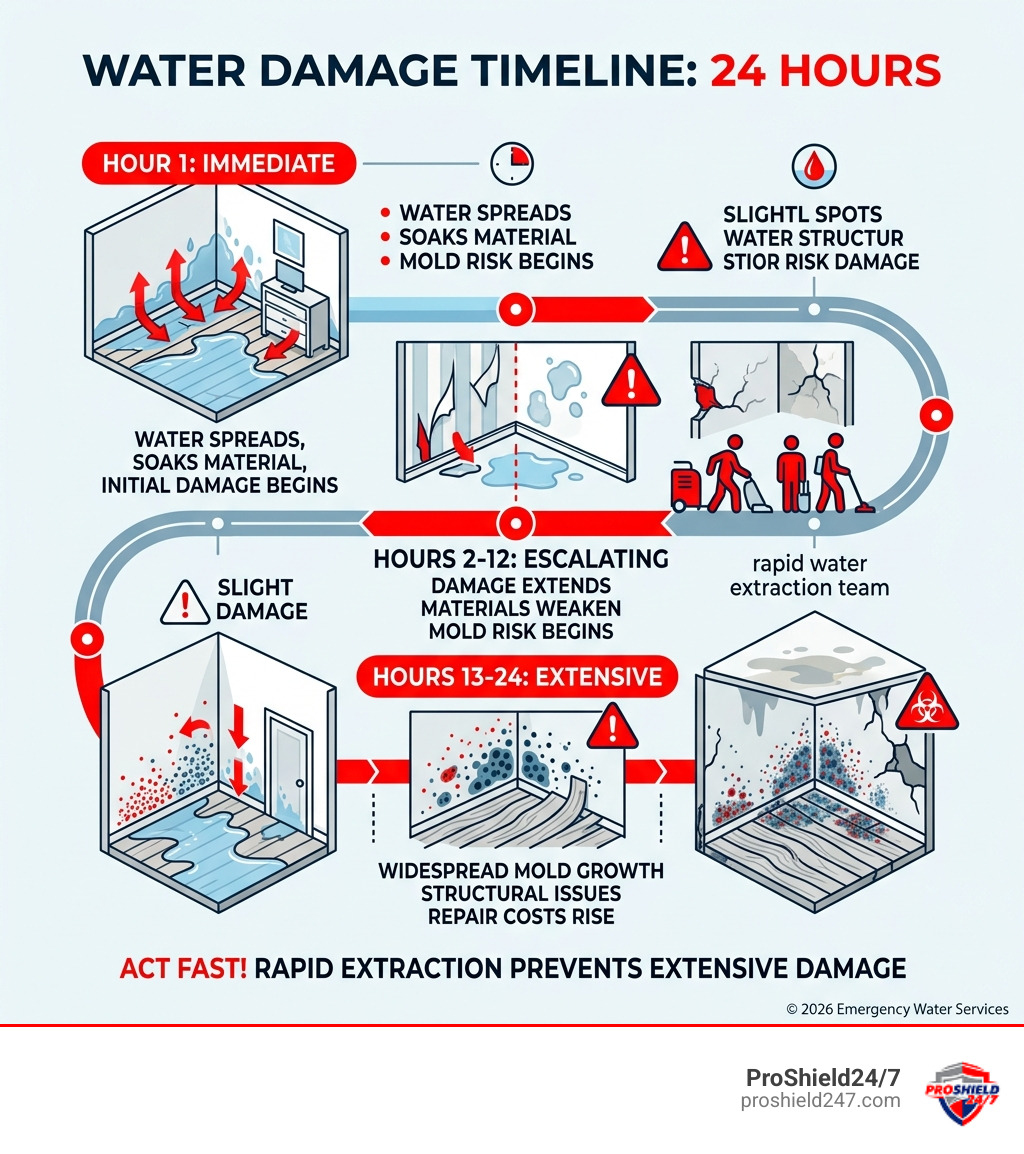
Prevent mold growth, which can begin within just 24-48 hours of water exposure
Dry and dehumidify all affected areas using commercial-grade equipment
Sanitize and deodorize to eliminate health hazards, including sewage contamination
Work directly with your insurance company to simplify the claims process
Water damage doesn't wait. A burst pipe, a flooded basement, or a leaking roof can go from a minor inconvenience to a serious structural problem in hours.
Standing water soaks into flooring, drywall, and framing almost immediately. Left untreated, it warps wood, weakens foundations, and creates the perfect conditions for mold. Repair costs can range from $1,300 to $5,600 — and that number climbs fast when damage spreads unchecked.
For Georgia homeowners especially, where storms and heavy rainfall are a regular reality, the difference between a manageable cleanup and a gut-wrenching renovation often comes down to one thing: how fast you act.
That's exactly why having access to a professional rapid water extraction team isn't just helpful — it's essential.
What is a Rapid Water Extraction Team and Why Speed Matters?
A rapid water extraction team is essentially the "First Responder" unit of the property world. While a general contractor might be great at rebuilding a kitchen, these specialized teams are focused entirely on one goal: stopping water from destroying your home’s bones.

In the restoration industry, we have a saying: "Water is a patient thief." It doesn't just sit on top of your hardwood floors; it migrates. It travels under baseboards, climbs up drywall through capillary action (think of how a paper towel sucks up a spill), and seeps into the subfloor.
The 24/7 Reality
Water damage rarely happens at 2:00 PM on a Tuesday when you're standing right there with a mop. It happens at 3:00 AM on a holiday weekend while you're asleep or away. A reputable rapid water extraction team provides 24/7/365 availability because they know that a 60-minute response time can be the difference between drying out a carpet and having to rip out the entire floor.
The Mold Window
One of the most critical reasons for speed is the 24-48 hour mold growth window. Mold spores are everywhere, but they need moisture to activate. Once a surface stays damp for more than a day or two, mold begins to colonize. By the time you see the black spots, the colony is already well-established. Rapid extraction stops this process before it starts.
Structural Integrity and Secondary Damage
Standing water is heavy and corrosive. It can cause:
Structural Instability: Saturated floor joists can lose their load-bearing capacity.
Secondary Damage: This is damage caused by high humidity, such as peeling wallpaper, warped furniture in other rooms, and "cupping" of wood floors.
Health Hazards: Depending on the source (like a sewage backup), standing water can contain pathogens that become airborne if not handled immediately.
Services Provided by a Rapid Water Extraction Team
These teams don't just "suck up water." Their service menu is comprehensive to ensure your home is safe to live in again:
Standing Water Removal: Using truck-mounted vacuums that can move thousands of gallons in minutes.
Moisture Mapping: Using non-invasive tools to find water hidden behind "dry" looking walls.
Sewage Cleanup: Handling "Black Water" (Category 3) which requires specialized hazmat protocols.
Deodorization: Neutralizing the musty proteins and odors that linger after a flood.
Sanitization: Applying antimicrobial treatments to prevent bacterial growth.
How Quickly Do Teams Respond to Emergencies?
In Georgia, we aim for immediate dispatch. Most elite teams can be on-site within 45 to 60 minutes. This rapid response is supported by strategically placed emergency vehicles loaded with industrial equipment, ensuring that help is never far away when a pipe bursts or a storm hits.
The Professional Water Extraction and Restoration Process
Professional restoration is a science, not just a cleaning job. It follows a specific set of IICRC (Institute of Inspection, Cleaning and Restoration Certification) standards to ensure the property is returned to its pre-loss condition.
Step 1: Inspection and Assessment
The team begins by identifying the "Category" of water (Clean, Grey, or Black) and the "Class" of damage (how much of the room is wet). They use moisture meters and thermal imaging to create a "map" of the disaster.
Step 2: Water Removal
This is the "extraction" phase. Using submersible pumps for deep water or truck-mounted vacuums for saturated carpets, the team removes the bulk of the liquid. This is the most important step because physical extraction is 1,200 times more efficient than dehumidification alone.
Step 3: Drying and Dehumidification
Once the standing water is gone, the "invisible" water remains. Industrial-grade air movers are placed to create high-velocity airflow across surfaces, while LGR (Low Grain Refrigerant) dehumidifiers pull moisture out of the air to prevent secondary damage.
Step 4: Monitoring
A rapid water extraction team doesn't just leave the fans and walk away. They return daily to take moisture readings, ensuring the drying process is moving along the "drying curve" and adjusting equipment as needed.
Extraction vs. Mitigation: What’s the Difference?
Many homeowners use these terms interchangeably, but they represent different stages of the save-your-home process.
Feature Water Extraction Water Mitigation Primary Goal Remove standing/surface water Prevent further damage & stabilize Key Actions Pumping, vacuuming, mopping Demolition of wet drywall, drying, sanitizing Equipment Truck-mounts, submersible pumps Air movers, dehumidifiers, air scrubbers Timeline Immediate (Hours 1-4) Ongoing (Days 1-5)
Advanced Technology Used by a Rapid Water Extraction Team
We’ve come a long way from the bucket and mop. Modern teams use:
Thermal Imaging Cameras: These see temperature differences. Since wet areas are usually cooler due to evaporation, these cameras "see" water inside a wall without having to tear the wall down.
LGR Dehumidifiers: These are much more powerful than the ones you buy at a hardware store; they can remove dozens of gallons of water from the air per day.
HEPA Air Scrubbers: These filter the air to remove dust, mold spores, and odors during the drying process.
Moisture Proto-meters: These give precise percentage readings of moisture inside wood and drywall.
Navigating Costs, Insurance, and Professional Qualifications
Let’s talk about the elephant in the room: the bill. Water damage repair costs can range from $1,300 to $5,600 on average, though major floods can certainly go higher.
The Insurance Factor
The good news is that most homeowners' insurance policies cover "sudden and accidental" water damage (like a burst pipe). A professional rapid water extraction team usually offers direct insurance billing. This means they document the damage with photos and moisture logs, submit the claim for you, and work with the adjuster to ensure the work is covered. This takes a massive weight off your shoulders during a crisis.
Professional Qualifications
You shouldn't hire just anyone with a shop-vac. A reputable team should possess:
IICRC Certification: Specifically WRT (Water Damage Restoration Technician) and ASD (Applied Structural Drying).
Licensed and Insured: This protects you if an accident happens on your property.
OSHA & HAZWOPER Compliance: This ensures the team follows federal safety standards, especially when dealing with contaminated water or mold.
Immediate Steps to Take Before the Rapid Water Extraction Team Arrives
While you wait for the pros to arrive (which should only be about 45-60 minutes), there are things you can do to minimize the damage.
Safety First: If the water is deep enough to reach electrical outlets, do not enter the room. Turn off the electricity at the breaker box if it is safe to reach.
Stop the Flow: If the damage is from a burst pipe, shut off the main water valve immediately.
Protect Your Belongings: Lift furniture off wet carpets. You can place aluminum foil or wood blocks under furniture legs to prevent "wicking" and permanent staining.
Document Everything: Take photos and videos of the standing water and the source of the leak. This is gold for your insurance claim.
Avoid DIY Pumping: Don't use your household vacuum to suck up water. You’ll likely ruin the vacuum and risk electrical shock.
Frequently Asked Questions about Water Extraction
How much does commercial water extraction cost?
Commercial costs are often higher than residential due to the scale and the need for specialized equipment like Emergency Response Trailers (ERTs). Factors include square footage, the "Category" of water (sewage costs more to clean than tap water), and how long the water has been sitting. Many businesses sign Emergency Response Agreements (ERA) to lock in pricing and guarantee priority response before a disaster happens.
What types of water damage can a team handle?
A professional rapid water extraction team is equipped for:
Burst Pipes: Common during Georgia's occasional deep freezes.
Appliance Overflows: Washing machines and dishwashers are frequent culprits.
Storm Flooding: Rising groundwater or roof leaks during heavy rains.
Sewage Backups: The most dangerous type of water damage.
Sump Pump Failure: When your basement’s defense system gives up.
What certifications should a reputable team possess?
At a minimum, look for IICRC S500 standards compliance. This is the "bible" of water restoration. Your team should have WRT (Water Restoration Technician) and ideally ASD (Applied Structural Drying) certifications. In Georgia, they should also be fully licensed and insured to perform mold remediation if the water has been sitting for more than 48 hours.
Conclusion
When your home is under water, panic is a natural reaction. But with a rapid water extraction team on speed dial, you can move from panic to action in minutes. By acting fast, you aren't just cleaning up a mess; you are preserving your home's structural integrity, protecting your family’s health from mold, and saving thousands of dollars in long-term repair costs.
In Georgia, the weather and humidity don't give you much of a "grace period." You need a team that understands the local climate and has the industrial-grade equipment to get the job done right the first time.
Don't let a leak turn into a legacy of mold and rot. If you're facing water damage right now, get professional help immediately.
Find out more about our professional restoration services or contact ProShield 24/7 for immediate emergency help—we are available 24/7 to get your home dry and safe again.
